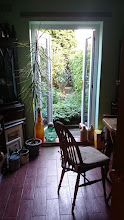
I'd forgotten just how lovely October can be with its gentle mists and soft yet cool, clear sunshine. When I walk down Heartbreak Hill in the mornings, robins and finches skitter in the hawthorn and, despite the slight troubles I have encountered lately, this fills me with gladness.
The leaves are turning and orange and brown predominate(I read somewhere that the glorious crimsons and purples of last year will not feature heavily this Autumn). Later berries and flowers still brighten up gardens but the petals on the Japanese Anenomies in our front garden are starting to fall. Winter is not far way but I do not dread it, despite the gradual reduction of light, which can bring on bouts of tired melancholy.
I have always been aware of the turning of the seasons throughout the years of my life, familiar markers on the journey and I am suddenly aware that today is a beautiful day to enjoy the gifts God has given me.
About Me
Saturday, 16 October 2010

Sunday, 3 October 2010
Back for Autumn
The Great tits and the Coal tits are back. Last seen in the Elder in early May, they disappeared for four months but now they are back, snacking on sunflower hearts and black sunflower seeds. The feeders are twirling.
Friday, 24 September 2010
Second visit to London
My second visit to London was probably a year or so later. My maternal great aunt, feeling I needed to get away from the sometimes toxic problems of my home life, took to me to visit Aunt Rachel in Morden.
Aunt Rachel was a bit of a legend in our family. Back in the late 50's her husband had won a fortune on the football pools. By 1969 the money had run out, most of it lost in a dodgy investment in a race course. The digging machines rusted away on the abandoned wasteland but Rachel managed to hold on to the house in Morden, where she lived with her son and youngest daughter.
This time, the train did not leave from Bolton and we travelled, not by special charter, but by Intercity from Manchester Piccadilly. Piccadilly was the biggest and most magnificent railway station I had seen. Its fabulous Victorian iron-girdered ceiling, still blackened from the smoke of steam locomotives, and its long platforms transported me to the same place as the opening pages of a new book: it promised good things to come. Stepping on the long train, holding on to my small suitcase with one hand and my aunt with the other, I knew this was a special journey.
Perhaps because I was sharing this journey with a woman in her early sixties and not with a gaggle of giggling, gossiping school girls, I became far more aware of my surroundings. I did not find the journey at all boring. I gazed through the windows as the train moved through the endless green countryside dotted with churches, cottages and farms, through the suburbs of little boxes and small factories and onwards into the city. On that visit I saw something I have never seen since: as we entered the suburbs of London, hanging from every balcony of every tenement, were rows and rows of washing. When I visited Rachel's again a year later, a change had taken place. There was far less washing. Maybe the weather was different or maybe the inhabitants had purchased tumble driers or taken, as my mother did, bags of wet washing to the launderette; perhaps they did the whole wash there? I don't know but as the 60's gave way to the 70's it seemed to me that the population's washing habits underwent a revolution. Washing lines didn't disappear but the sheer volume of wet shirts, skirts and knickers decorating the edges of the West Coast Line was severely reduced.
Euston station was just the same but this time there was no embarrassing Beatles bag and no coach. Instead Aunt Eliza took me down the short escalator into the tube station. We purchased our ticket at the wooden window and took a much longer ride down to the platforms.
I stood on the platform full of wonder and half afraid. When the train clattered into the station, I was scared the force of it might drag me on to the live rail, which Aunt Eliza had sternly explained would kill me should I fall upon it.
Inside the train I was transfixed by the map of the Northern Line on the opposite wall above the heads of the passengers. We passed beneath Tottenham Court Road, Leicester Square and Charing Cross and then moved out to Elephant and Castle, Kennington, Oval, Stockwell and North Clapham. At some point we came up from the tunnels and into daylight as I checked each station off against the thick brownish-black line opposite: Balham, Tooting Bec, Tooting Broadway, Colliers Wood, South Wimbledon and finally Morden.
After such a wonderful ride through unknown places, Morden was a dreadful anti-climax; to a child who'd grown up in the heartland of the industrial North, South London surburbia seemed incredibly dull. All it had to recommend it was the eerie white light of the street lamps, which illuminated the long avenue where Rachel lived.
I don't recall much about that first visit to Rachel's, apart from spending time with my cousin Caroline and listening to 45's on the radiogram in the sitting room but that ride on the underground, where I first discovered the incantational power of place names and first experienced the strange and almost obsessional pull the capital city had on my imagination, was significant.
Related Posts:
Creative Writing - First visit to London
Memories for Mother's Day: Those who went before

Aunt Rachel was a bit of a legend in our family. Back in the late 50's her husband had won a fortune on the football pools. By 1969 the money had run out, most of it lost in a dodgy investment in a race course. The digging machines rusted away on the abandoned wasteland but Rachel managed to hold on to the house in Morden, where she lived with her son and youngest daughter.
This time, the train did not leave from Bolton and we travelled, not by special charter, but by Intercity from Manchester Piccadilly. Piccadilly was the biggest and most magnificent railway station I had seen. Its fabulous Victorian iron-girdered ceiling, still blackened from the smoke of steam locomotives, and its long platforms transported me to the same place as the opening pages of a new book: it promised good things to come. Stepping on the long train, holding on to my small suitcase with one hand and my aunt with the other, I knew this was a special journey.
Perhaps because I was sharing this journey with a woman in her early sixties and not with a gaggle of giggling, gossiping school girls, I became far more aware of my surroundings. I did not find the journey at all boring. I gazed through the windows as the train moved through the endless green countryside dotted with churches, cottages and farms, through the suburbs of little boxes and small factories and onwards into the city. On that visit I saw something I have never seen since: as we entered the suburbs of London, hanging from every balcony of every tenement, were rows and rows of washing. When I visited Rachel's again a year later, a change had taken place. There was far less washing. Maybe the weather was different or maybe the inhabitants had purchased tumble driers or taken, as my mother did, bags of wet washing to the launderette; perhaps they did the whole wash there? I don't know but as the 60's gave way to the 70's it seemed to me that the population's washing habits underwent a revolution. Washing lines didn't disappear but the sheer volume of wet shirts, skirts and knickers decorating the edges of the West Coast Line was severely reduced.
Euston station was just the same but this time there was no embarrassing Beatles bag and no coach. Instead Aunt Eliza took me down the short escalator into the tube station. We purchased our ticket at the wooden window and took a much longer ride down to the platforms.
I stood on the platform full of wonder and half afraid. When the train clattered into the station, I was scared the force of it might drag me on to the live rail, which Aunt Eliza had sternly explained would kill me should I fall upon it.
Inside the train I was transfixed by the map of the Northern Line on the opposite wall above the heads of the passengers. We passed beneath Tottenham Court Road, Leicester Square and Charing Cross and then moved out to Elephant and Castle, Kennington, Oval, Stockwell and North Clapham. At some point we came up from the tunnels and into daylight as I checked each station off against the thick brownish-black line opposite: Balham, Tooting Bec, Tooting Broadway, Colliers Wood, South Wimbledon and finally Morden.
After such a wonderful ride through unknown places, Morden was a dreadful anti-climax; to a child who'd grown up in the heartland of the industrial North, South London surburbia seemed incredibly dull. All it had to recommend it was the eerie white light of the street lamps, which illuminated the long avenue where Rachel lived.
I don't recall much about that first visit to Rachel's, apart from spending time with my cousin Caroline and listening to 45's on the radiogram in the sitting room but that ride on the underground, where I first discovered the incantational power of place names and first experienced the strange and almost obsessional pull the capital city had on my imagination, was significant.
Related Posts:
Creative Writing - First visit to London
Memories for Mother's Day: Those who went before

Sunday, 5 September 2010
Creative Writing
Last night we had a Sarah's Book Group social on the theme of journeys/places. We could either read something we had written, read something written by someone else, or talk about a journey. This was my effort:
First trip to London
The first time I visited London was in 1968, when I was ten years old, on a school trip. We went on a specially chartered train early in the morning from Bolton station. The journey took about three-and –a-half hours.
On this journey, I had a real problem. The problem came in the shape of a big, brown leather bag in which my mother had packed my lunch. The bag was about four years old and had a picture of the Beatles on it. The Beatles were no longer the group of smiling mop tops shown in the picture. They had transformed into tripped out and rather hairy looking hippies. At ten the idea of being so publically out of date was already an anathema. And out of date in London! (sigh) It was almost too much to bear.
The bag was a cast off from our next door neighbour, Pauline Kimmer. Pauline was buxom, married to a pleasant, greasy haired biker with the largest workman’s bum in Bolton and was the owner of two Alsatian dogs. These dogs were a trial to me. They barked constantly and regularly placed their front paws on the wall between the two properties and stared at me with menace. One day one of them got over the wall and chased me down the yard, where I hid in the outside lavatory for over an hour. And so, having condemned me to a life long anxiety about Alsatian dogs, Pauline innocently contributed to a longstanding fear of potential social embarrassment.
Eventually, we arrived at Euston. I walked across the concourse, photo side of bag face inward and gripped firmly against my side and was directed to a coach where we began our itinerary.
First stop was the Tate Gallery. This was full of landscapes and paintings of large ladies wearing nothing more than thin strips of floating fabric, which occasionally covered their 'naughty bits'. Everyone, apart from a few rude boys and the teachers, rightfully condemned this as very boring. Next was Hampton Court, where we not allowed in the maze in case we got lost and I imagine that’s where we probably ate our sandwiches. I have no memory of how I managed to hide the picture of the Beatles as I opened the front of the bag to free my lunch. I assume the memory to have been so traumatic I automatically repressed it.
Having checked no one had accidentally wandered into the maze, the teachers led us back to the coach and we were bound for Windsor. On the way there we went through Harrow and were shocked to see teenage boys dressed in tail coats and top hats walking through the streets. We banged on the windows, pointed and pulled faces at this bizarre spectacle. However young and uneducated we might be, we knew our class enemies when we saw them.
I liked filing around Windsor castle with its roped off walkways, its chintzy chairs, Indian print carpets and paintings of noble stags in Scottish glens. This was where the queen lived and, despite the class war, I still share her taste in carpets.
From Windsor we were placed on a boat for our trip down the Thames back to central London. It was a sunny afternoon and we took photographs of each other and the river. I think it was the first time I was let loose with a camera: a Kodak 125. For years I had a photograph of a smiling Elizabeth Nowak partly obscured by my thumb.
As the afternoon drew on, we began to get hungry. ‘Don’t worry,’ said the teachers, ‘You’ll be having tea soon.’ Mmmnnn we thought, tea. Images of sausage rolls and cakes or maybe sausage and mash, or maybe even boiled beef and carrots – wasn’t that what they ate in London? - floated into my mind.
Eventually - it takes forever to sail down the Thames on a cruiser - we were called below decks for our tea. On the table in front of us were placed piles of jam sandwiches and plates of jam tarts. Jam sandwiches! Only the poor – or the kids in Enid Blyton books actually had jam sandwiches for tea! And jam tarts? Jam tarts are shite, especially when the jam is orange and yellow! This wasn’t tea. It was rubbish!
I don’t remember much about sailing past the Houses of Parliament or getting off the cruiser or getting back on the train. I was probably too cross about the terrible tea. The journey home seemed to take even longer than the one going, especially as I was starving: one packed lunch and three tiny jam butty quarters were not enough to sustain a growing girl.
The next day a small delegation of mothers turned up at the school demanding a partial refund on the £5.00 they had paid for the trip. What none of us realised was that, in London, such fare could pass for tea. Brought up on the Industrial North-West, we described what the South (and possibly the Northern Middle Classes) called dinner as 'our tea'. But, on reflection, it really was a piss poor afternoon tea. Where was the salmon? Where was the cucumber? Where were the scones and cream?
I don’t know if the delegation of mothers ever got their money back. What I do know is that I never took the brown leather bag with the picture of the Beatles on the front anywhere ever again.
First trip to London
The first time I visited London was in 1968, when I was ten years old, on a school trip. We went on a specially chartered train early in the morning from Bolton station. The journey took about three-and –a-half hours.
On this journey, I had a real problem. The problem came in the shape of a big, brown leather bag in which my mother had packed my lunch. The bag was about four years old and had a picture of the Beatles on it. The Beatles were no longer the group of smiling mop tops shown in the picture. They had transformed into tripped out and rather hairy looking hippies. At ten the idea of being so publically out of date was already an anathema. And out of date in London! (sigh) It was almost too much to bear.
The bag was a cast off from our next door neighbour, Pauline Kimmer. Pauline was buxom, married to a pleasant, greasy haired biker with the largest workman’s bum in Bolton and was the owner of two Alsatian dogs. These dogs were a trial to me. They barked constantly and regularly placed their front paws on the wall between the two properties and stared at me with menace. One day one of them got over the wall and chased me down the yard, where I hid in the outside lavatory for over an hour. And so, having condemned me to a life long anxiety about Alsatian dogs, Pauline innocently contributed to a longstanding fear of potential social embarrassment.
Eventually, we arrived at Euston. I walked across the concourse, photo side of bag face inward and gripped firmly against my side and was directed to a coach where we began our itinerary.
First stop was the Tate Gallery. This was full of landscapes and paintings of large ladies wearing nothing more than thin strips of floating fabric, which occasionally covered their 'naughty bits'. Everyone, apart from a few rude boys and the teachers, rightfully condemned this as very boring. Next was Hampton Court, where we not allowed in the maze in case we got lost and I imagine that’s where we probably ate our sandwiches. I have no memory of how I managed to hide the picture of the Beatles as I opened the front of the bag to free my lunch. I assume the memory to have been so traumatic I automatically repressed it.
Having checked no one had accidentally wandered into the maze, the teachers led us back to the coach and we were bound for Windsor. On the way there we went through Harrow and were shocked to see teenage boys dressed in tail coats and top hats walking through the streets. We banged on the windows, pointed and pulled faces at this bizarre spectacle. However young and uneducated we might be, we knew our class enemies when we saw them.
I liked filing around Windsor castle with its roped off walkways, its chintzy chairs, Indian print carpets and paintings of noble stags in Scottish glens. This was where the queen lived and, despite the class war, I still share her taste in carpets.
From Windsor we were placed on a boat for our trip down the Thames back to central London. It was a sunny afternoon and we took photographs of each other and the river. I think it was the first time I was let loose with a camera: a Kodak 125. For years I had a photograph of a smiling Elizabeth Nowak partly obscured by my thumb.
As the afternoon drew on, we began to get hungry. ‘Don’t worry,’ said the teachers, ‘You’ll be having tea soon.’ Mmmnnn we thought, tea. Images of sausage rolls and cakes or maybe sausage and mash, or maybe even boiled beef and carrots – wasn’t that what they ate in London? - floated into my mind.
Eventually - it takes forever to sail down the Thames on a cruiser - we were called below decks for our tea. On the table in front of us were placed piles of jam sandwiches and plates of jam tarts. Jam sandwiches! Only the poor – or the kids in Enid Blyton books actually had jam sandwiches for tea! And jam tarts? Jam tarts are shite, especially when the jam is orange and yellow! This wasn’t tea. It was rubbish!
I don’t remember much about sailing past the Houses of Parliament or getting off the cruiser or getting back on the train. I was probably too cross about the terrible tea. The journey home seemed to take even longer than the one going, especially as I was starving: one packed lunch and three tiny jam butty quarters were not enough to sustain a growing girl.
The next day a small delegation of mothers turned up at the school demanding a partial refund on the £5.00 they had paid for the trip. What none of us realised was that, in London, such fare could pass for tea. Brought up on the Industrial North-West, we described what the South (and possibly the Northern Middle Classes) called dinner as 'our tea'. But, on reflection, it really was a piss poor afternoon tea. Where was the salmon? Where was the cucumber? Where were the scones and cream?
I don’t know if the delegation of mothers ever got their money back. What I do know is that I never took the brown leather bag with the picture of the Beatles on the front anywhere ever again.
Thursday, 2 September 2010
Elderberries
The shiny purple bunches of elderberries hang on the tree and sparkle in the August sunshine. The birds just love them. Starlings, blue tits, collared doves and sparrows enjoy the natural feast. The goldfinches aren't interested at all. Maybe their beaks are too thin for this type of berry/seed or maybe they just don't like them, preferring to fight over sunflower hearts and nyger seeds.
Friday, 20 August 2010
Greenfinches
Yesterday, Baz said there had been an feature on BBC Breakfast about the drop in greenfinch numbers but he'd had to leave for work before the detail came on. An article in yesterday's Telegraph gives the cause as trichomonosis, a disease which normally affects pigeons but has been affecting greenfinches and chaffinches for five or so years now. The British Trust for Ornithology, who carried out the research with help from the general public, are very concerned. On their web site they recommend, regular sterilization of feeders and, if sign of disease are noted, to stop feeding birds for a period of around 2 weeks then re-introduce food gradually, keeping an eye on the situation.
I have not noticed any sick birds but there's a clearly been an absence of greenfinches. The population is declining by 1 in 3.
I have not noticed any sick birds but there's a clearly been an absence of greenfinches. The population is declining by 1 in 3.
Monday, 16 August 2010
Nature Notes
When out walking, it’s so noticeable how Himalayan balsam is colonising our open spaces, not just the edges of paths but across uncultivated fields and partly dried up streams. Pretty enough, there’s just too much of it. It is far more prolific than rosebay willowherb and may be driving out more familiar plants, affecting diversity. It’s creeping up Nelly’s Clough like a nasty rash. (I’d better explain: Nelly’s Clough is a path that weaves past the golf course and farm land near the end of my road and not an elderly woman with a sexual health problem!)
Despite this intrusion, Nelly is looking good at the moment with hawthorn, elder, blackberry brambles full of fruit and nettles, dock, rosebay willowherb, vetch and ragwort lining the edges of the path. On the slope down to the stream there are crab apple trees and a couple of splendid fuchsias that must have seeded years ago from a nearby garden.
I saw a heron at Wallsuches alongside coots, Canada geese and mallards.There are more butterflies about than last year. I saw peacocks, spotted woods, small coppers and small tortoiseshells along the way. At Wallsuches five peacocks lay sunning themselves on the path till I disturbed them. I also came across some exotic breeds. Two brown and patchy long horn goats (I think they were goats!) grazed in a field near Brinks Row, while a couple of Lamas relaxed in the sun at the top of Green Lane.
In the garden we have seen plenty of goldfinches and sparrows, though not too many sightings of greenfinches at the moment. Earlier I peered in the sunken blue bowl and saw the frog peeping up from the murky rain water. I then made the mistake of saying ‘hello’. The frog jumped. I jumped. It jumped some more and then hid out for a while behind the flower pots. If it’s the same frog that was in there last year it sure has grown.
Despite this intrusion, Nelly is looking good at the moment with hawthorn, elder, blackberry brambles full of fruit and nettles, dock, rosebay willowherb, vetch and ragwort lining the edges of the path. On the slope down to the stream there are crab apple trees and a couple of splendid fuchsias that must have seeded years ago from a nearby garden.
I saw a heron at Wallsuches alongside coots, Canada geese and mallards.There are more butterflies about than last year. I saw peacocks, spotted woods, small coppers and small tortoiseshells along the way. At Wallsuches five peacocks lay sunning themselves on the path till I disturbed them. I also came across some exotic breeds. Two brown and patchy long horn goats (I think they were goats!) grazed in a field near Brinks Row, while a couple of Lamas relaxed in the sun at the top of Green Lane.
In the garden we have seen plenty of goldfinches and sparrows, though not too many sightings of greenfinches at the moment. Earlier I peered in the sunken blue bowl and saw the frog peeping up from the murky rain water. I then made the mistake of saying ‘hello’. The frog jumped. I jumped. It jumped some more and then hid out for a while behind the flower pots. If it’s the same frog that was in there last year it sure has grown.
Subscribe to:
Posts (Atom)